
Just last month, a client came to us with a single customer security questionnaire with 50 questions about AI. Why should you care? If you added an AI feature, signed up with an AI vendor, or let an AI agent start writing code or reviewing pull requests since your last report, AI is now part of your SOC 2 controls, whether or not your report says so yet. Unsurprisingly, AI is one of the most common topics I'm discussing with clients this year.
Does AI need to be in your SOC 2 report?
If AI is part of your product or how you deliver your service, it likely needs to be in-scope for your SOC 2. Including it shows your customers and prospects you take security seriously, but there’s also a practical reason for including it - to efficiently address AI questions in security questionnaires and from prospects. Your sales lead may not know the right answer to “will my data be used to train AI models” - but your SOC 2 should. Including AI in your SOC 2 doesn’t need to be a major overhaul - the SOC 2 trust services criteria you're already tested against still apply. What changes is what your controls cover and how your report describes your system.
AI usually enters scope in one of four ways:
An AI feature in your product processes customer data
A third-party AI provider, such as a model API, AI support tool, or transcription service, receives customer data
Engineers use AI tools to write or review code that ships to production
Your team uses AI assistants or agents that can see customer data or take actions in your systems
What will customers ask about AI and their data?
Not every customer will send a 50-question AI questionnaire, but most will ask some version of these:
Is our data used to train AI models, yours or your providers’?
Can we turn AI features off?
Which AI providers receive our data, and will you tell us when that list changes?
Do you have an AI policy?
Who can see our prompts, outputs, and logs?
How long do your AI providers keep our data, and where is it processed?
How are your AI systems secured, and is AI activity logged and monitored?
Does your SOC 2 report actually cover your AI features?
The last question matters most. If your report doesn't describe your AI yet, the honest answer may be no. The fix isn’t a new framework. It’s describing your AI uses in your SOC 2 report and backing your questionnaire answers with controls you can actually show, before your next audit’s testing starts.
Why cover AI in your SOC 2 before customers ask?
Getting AI into your report isn’t only about passing the audit. Done before anyone forces it, it pays off in ways your sales and product teams will notice:
Faster security reviews. When your report already covers whether customer data trains AI models, which AI providers receive it, and how AI activity is logged and monitored, you can point customers to it instead of writing new answers for every questionnaire. That keeps deals from stalling in procurement.
AI features become a selling point. Buyers are cautious about AI. A report that shows the controls around your AI features gives their security team a reason to say yes instead of a reason to dig deeper.
A head start. Many SOC 2 reports don’t mention AI yet. Being able to say “it’s covered in our report” sets you apart from vendors still answering from scratch.
No last-minute scramble. If a big customer raises AI right before your next audit, you’re reworking controls under pressure, and that’s when exceptions happen. On your own schedule, it’s a planned update.
Room to keep building. Once AI runs through your normal vendor management, data security, and change management controls, shipping a new AI feature becomes routine.
What changes in this year’s audit when AI is in scope?
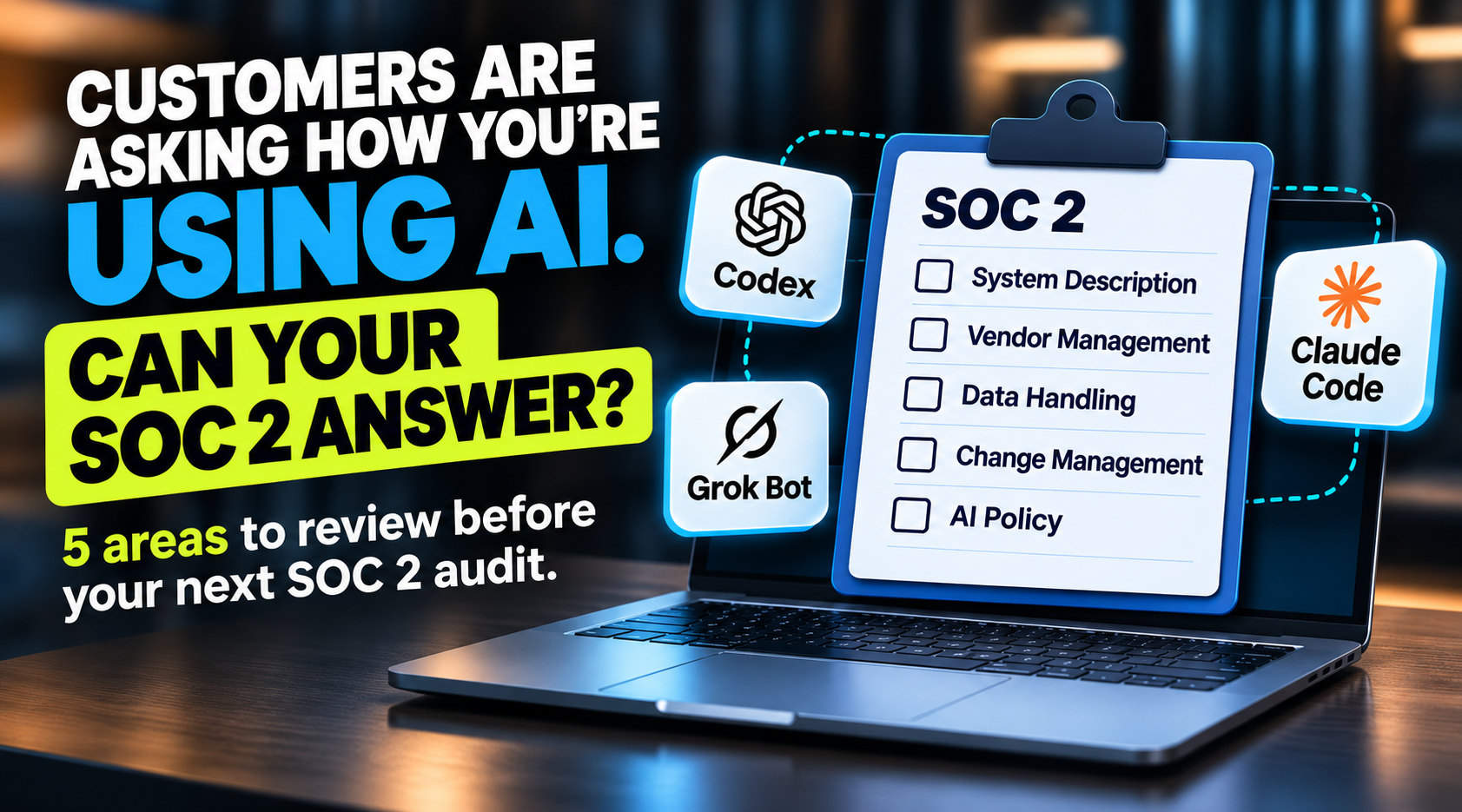
Five areas usually need an update: the system description, vendor management, data handling, change management and your AI policy. None of them needs a new program. Each needs to cover AI honestly.
| Area | What to update before your next audit |
|---|---|
| System description | Describe AI features, AI providers, and how customer data moves between them |
| Vendor management | Add AI providers to the vendor listing, perform risk assessments for prospective AI vendors, and establish agreements that specify restrictions on data training and retention. |
| Data handling | Document what data goes into prompts, where it's stored, and whether it can train a model. |
| Change management | Track and approve model, prompt, and configuration changes like code. Establish expectations for AI code reviews and AI-generated source code - when is human in the loop expected? |
| AI policy | Match the policy to how your team actually works, with a list of approved tools and expectations for use. Be practical - banning all AI use is not the answer. |
How should your system description cover AI?
Your system description (often called Section 3) should name the AI features and providers that touch customer data and show how data flows between them. For a provider that performs part of your service, talk with your auditor about whether it should be presented as a subservice organization, and which controls you rely on it to operate.
How do you handle AI vendors in SOC 2 vendor management?
Treat AI providers like any other vendor that touches customer data. You don't need a new process, you need to include them in the one you have.
- Collect each provider's SOC 2 report or equivalent and review it, including the controls it expects you to tackle (complementary user entity controls)
- Check contracts and account settings for data retention and model training on your data
- Review new AI vendors before onboarding - do they have a SOC 2? Can they sign a BAA if you need one?
- Keep an inventory of approved AI tools, so "unapproved tools" in your policy has a clear meaning
- Specify approved use cases, if they vary by vendor. You may approve one tool for use with client data, and another only for general purpose. Document accordingly.
How do model and prompt changes fit into change management?
Treat them like code. A change to a model, a prompt, or an AI configuration can change how your product behaves as much as a code change, so it belongs in the same tracked, reviewed, and approved process.
- Version prompts and model configurations alongside your code, or in another tracked system
- Route material changes through your normal ticket, review, and approval path
- Test changes before release and record what was tested
- If an AI tool reviews pull requests, keep a human approver or document when one isn’t necessary - you may want to make sure your auditor is on board with your approach
Can AI do the audit itself?
Some of our most AI-forward clients have asked us, half-joking, to “just have our AI talk to your AI and send the SOC 2 report.” I get it. But a SOC 2 report is an independent opinion, and only a licensed CPA firm can issue it. AI can’t sign that opinion, and it can’t replace the auditor’s judgment about whether your controls actually worked.
What AI can do is take a lot of busywork out of the process. At Eye & Co., when your team walks us through a process on a recorded call, we use AI to analyze the transcript, so each control is tied to a timestamp in the recording and the screenshots come from the video, not from your team, so no one on your side is stuck collecting screenshots. Our auditors still test every control and reach every conclusion.
What should you do before your next annual audit kicks off?
- List AI features, providers, and internal tools that touch customer data or production code.
- Update your system description to match.
- Add AI providers to vendor management.
- Write down how customer data flows into and out of AI features.
- Bring model, prompt, and configuration changes into change management.
- Align your AI policy with how your team actually works.
FAQ
Is there a separate SOC 2 category for AI?
No. The Trust Services Criteria have five categories: Security, Availability, Processing Integrity, Confidentiality and Privacy. AI is evaluated through those existing criteria.
Does an AI code reviewer count as the second reviewer?
Potentially. AI review can add real value, but auditors will generally look for evidence that a person approved the change unless you designed the process to allow for changes without human in the loop. It depends on how your control is written.
Do we need our AI vendor's SOC 2 report?
If the vendor handles customer data, get its SOC 2 report or equivalent assurance. If none exists, document the other due diligence you did.
Will adding AI cause exceptions in our report?
Not by itself. Exceptions come from controls that don't operate as described. Updating your description and controls early lowers that risk.
Is it worth adding AI to my SOC 2 before customers ask?
Yes, if AI already touches customer data or production code. Customers are already asking, and a report that covers AI lets you answer from the same evidence your auditor tested instead of starting from scratch each time. Doing it ahead of your next audit also makes it a planned update rather than a rush that can lead to exceptions.
Is there an AI-specific certification?
ISO/IEC 42001, published in 2023, is a management system standard for AI. Some companies pursue it alongside SOC 2 when customers ask for AI-specific assurance.
Can AI do my SOC 2 audit?
No. A SOC 2 report is an attestation that only an independent, licensed CPA firm can issue, so AI can’t issue it or stand in for the auditor’s judgment. AI can make the work faster on both sides, like processing walkthrough recordings, but a person still has to test your controls and stand behind the opinion.
Want to talk through how AI fits into your SOC 2?
AI is changing what customers expect from your security and compliance program, and the right answers aren’t always obvious. If you’d like a second set of experienced eyes, set up a time with me directly (Kate Eye, CEO, Founder and Lead SOC 2 Partner at Eye & Co.). We’ll talk through where AI touches your report, your questionnaires and your controls, and what’s worth tackling before your next audit.
Sources
- AICPA & CIMA, "2017 Trust Services Criteria (With Revised Points of Focus – 2022)": https://www.aicpa-cima.com/resources/download/2017-trust-services-criteria-with-revised-points-of-focus-2022
- ISO, "ISO/IEC 42001:2023 AI management systems": https://www.iso.org/standard/42001
- NIST, "AI Risk Management Framework" (further reading): https://www.nist.gov/itl/ai-risk-management-framework
- Journal of Accountancy, “SOC engagements: Ethics risks with tool providers” (April 2026): https://www.journalofaccountancy.com/issues/2026/apr/soc-engagements-ethics-risks-with-tool-providers/
- Journal of Accountancy, “AICPA guides peer reviewers to address SOC 2 risks” (May 2026): https://www.journalofaccountancy.com/issues/2026/may/aicpa-guides-peer-reviewers-to-address-soc-2-risks/
